Mastering Your Schedule: The Ultimate Guide to Vis...
14 May, 2026

by admin
| 29 Dec' 2025
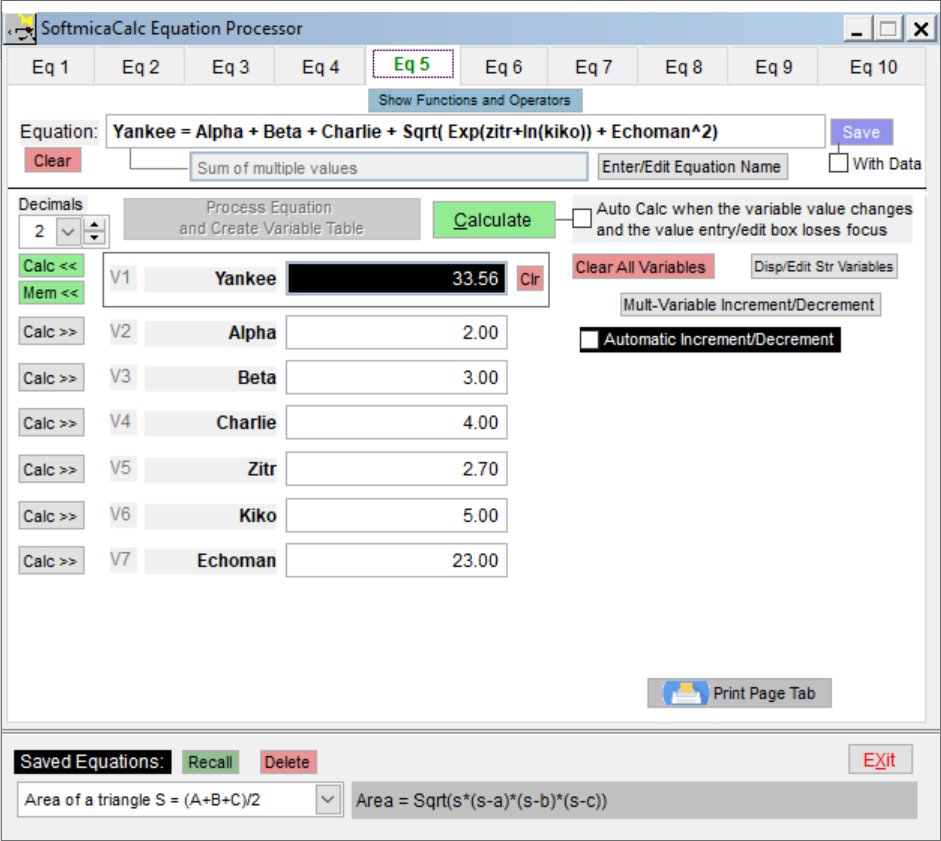
Modern problem-solving often involves equations that go beyond basic arithmetic. Engineers work with multi-variable formulas, finance professionals analyse compound expressions, and students deal with advanced scientific calculations. Solving these custom mathematical equations manually can be time-consuming and error-prone. An advanced calculator simplifies this process by allowing users to input complete expressions, define variables, apply built-in functions, and receive accurate results with clear evaluation flow.
Custom mathematical equations are expressions created by the user rather than predefined formulas. These equations may include:
• Multiple variables
• Real-world formula structures used in science, finance, and engineering
An advanced calculator is designed to interpret these expressions logically, following proper mathematical rules and operation order.
Unlike basic calculators, advanced calculators are built to handle full expressions from start to finish. They:
• Accept complete equations instead of single-step inputs
• Process variable-based calculations
• Apply built-in mathematical functions correctly
• Maintain calculation accuracy even with complex formulas
This makes them ideal for users who require reliable and repeatable results across different use cases.
The first step in solving a custom equation is accurate input. An advanced calculator allows users to:
• Enter mathematical expressions in a natural, readable format
• Define variables and assign values clearly
• Combine numbers, symbols, and functions in a single expression
Clear input structure ensures that the calculator interprets the equation exactly as intended.
Once the expression is entered, the Equation Processor Calculator evaluates it using proper mathematical order:
• Parentheses and grouping are resolved first
• Functions and exponents are calculated next
• Multiplication, division, addition, and subtraction follow
This structured evaluation mirrors step-by-step problem solving, reducing the risk of logical errors and miscalculations.
After evaluation, the calculator provides the final result in a clean and understandable format. This clarity helps users:
• Verify correctness instantly
• Adjust variable values and re-evaluate quickly
• Compare multiple scenarios without rebuilding the equation
Accurate output is especially valuable in engineering models, financial forecasting, and scientific analysis.
Advanced equation solvers are widely used in:
interest calculations, growth models, and analytical expressions
algebraic expressions, physics formulas, and research computations
The ability to reuse and modify equations makes advanced calculators practical across disciplines.
Using an advanced calculator offers several advantages:
• Saves time by eliminating manual steps
• Reduces calculation errors
• Supports complex, variable-based expressions
• Improves understanding through structured evaluation
These benefits make it a dependable tool for both professionals and learners.
Solving custom mathematical equations does not need to be complicated. With an advanced calculator that supports variables, built-in functions, and structured evaluation, users can focus on problem-solving rather than computation errors. From input to evaluation to output, Equation Processor Calculator provide clarity, accuracy, and efficiency for complex mathematical needs.